
With heart valve disease, timing matters. Treatment too early can expose a patient to procedure risk before there is enough benefit. Waiting too long can allow the heart muscle, lungs or heart rhythm to be affected.
The main questions are simple: which valve is affected, how severe the problem is, whether symptoms are related to the valve, and whether the heart is showing strain.
In clinic, the difficult part is often linking the scan to the person. A label such as “moderate” or “severe” is not enough on its own. The pattern of symptoms, exercise tolerance, rhythm, heart size and change over time all affect the decision.
The common valve problems
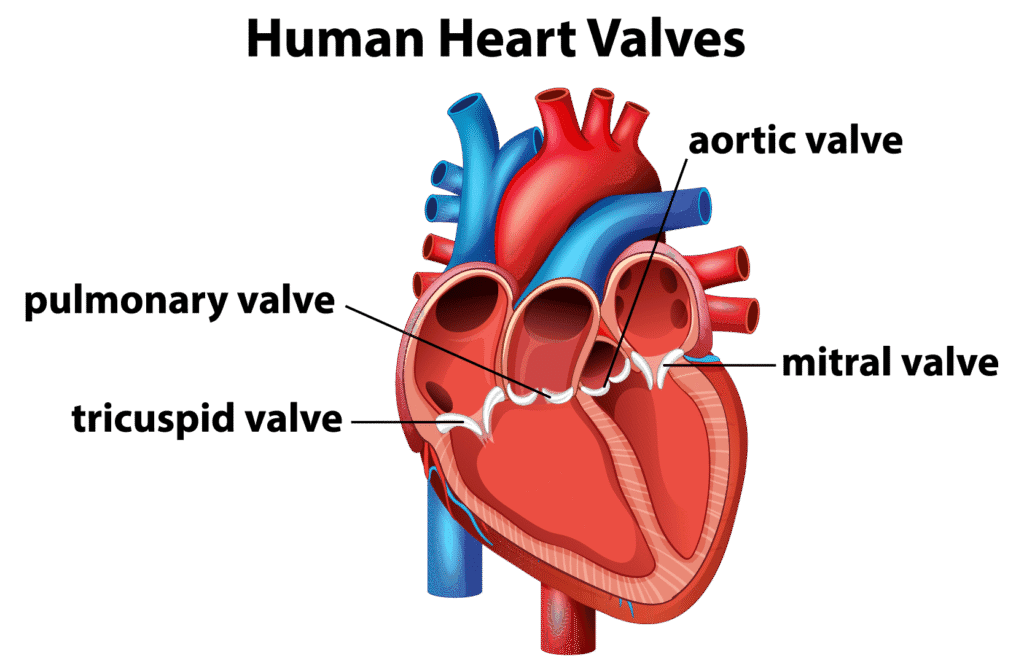
The heart has four valves: aortic, mitral, tricuspid and pulmonary. In adult cardiology clinics, the aortic and mitral valves are discussed most often.
Valve disease usually means one of two things. A valve may be narrowed, so blood struggles to pass through. This is called stenosis. Or a valve may leak backwards. This is called regurgitation.
Mild leakage is common and often needs no treatment, although context matters. Moderate or severe valve disease needs more careful follow-up and sometimes assessment by a valve team.
Symptoms are important, but not enough
Symptoms such as breathlessness, chest tightness, dizziness, blackouts, ankle swelling and reduced exercise capacity can suggest significant valve disease. Fainting during exertion with a heart murmur is a warning sign. UK guidance supports urgent specialist assessment, usually within 2 weeks.
Symptoms can creep up slowly. Some people stop walking uphill, avoid stairs, or reduce activity without realising they have changed their habits. They may then describe themselves as symptom-free.
That is one of the common traps in valve disease. The patient may not be truly well; they may simply have adapted their life around the valve problem.
Breathlessness can also come from lung disease, anaemia, weight change, lack of fitness, rhythm problems or heart artery disease. That is why symptoms and scan findings have to be interpreted together.
What an echocardiogram measures
A transthoracic echocardiogram is the main test for most valve disease. It is an ultrasound scan of the heart.
Echo looks at the valve appearance, narrowing, leaking, heart pumping function, heart size and pressure clues. When a particular valve question cannot be answered fully from the chest, transoesophageal echocardiography may provide more detailed images. It can also show whether the heart is starting to enlarge or weaken because of the valve problem.
For aortic valve narrowing, echo measures how fast blood passes through the valve and how tight the valve appears. For mitral valve leakage, it looks at how much blood leaks backwards and whether the left side of the heart is enlarging.
A report saying mild, moderate or severe is useful, but the change over time also matters. A valve that is stable for years is different from one that is getting worse.
When CT or MRI may be needed
CT and MRI do not replace echo for most valve checks, but they can add useful information.
CT can help measure calcium in the aortic valve and plan some procedures. MRI can help when echo pictures are limited or when more accurate heart size and leak measurements are needed.
When specialist valve assessment is needed
UK guidance supports specialist referral for moderate or severe valve disease of any type. It also supports referral for bicuspid aortic valve disease, even when mild. A bicuspid aortic valve is a valve with two leaflets instead of the usual three.
Valve treatment is usually considered when valve disease is severe and causing symptoms, or when severe disease is starting to affect the heart before symptoms are obvious. The decision depends on symptoms, scan findings, heart size, pumping function, pressure clues, rhythm and overall health.
Why timing matters
Valve treatment is about more than fixing a valve. It is also about protecting the heart muscle, lungs and heart rhythm before avoidable deterioration occurs.
In severe aortic valve narrowing, waiting for advanced symptoms can be dangerous. In severe valve leakage, the heart may enlarge gradually before the patient feels very limited. Good timing needs repeat measurements, symptom review and a clear plan for escalation.
Private valve assessment
Dr Cassar can assess heart valve disease, review previous echo reports and arrange updated imaging where needed. The consultation helps decide whether the valve disease is mild and safely monitored, moderate and needing structured follow-up, or severe and needing referral for valve team discussion.
The cardiology services page explains the imaging and assessment available privately. For consultation details, see the appointments page.
Questions patients often ask
Does a heart murmur always mean valve disease?
No. Some murmurs are harmless. But a murmur with symptoms, an abnormal ECG, older age, atrial fibrillation or signs of aortic valve narrowing should usually be checked with an echocardiogram.
Is mild valve leakage serious?
Often not. Mild leakage is common and may need no treatment. Advice depends on the valve, the cause and the rest of the echo.
When is valve disease urgent?
Urgency increases with severe breathlessness, chest pain, blackouts, fainting during exertion, heart failure signs, or a murmur suggesting severe aortic valve narrowing. Sudden severe symptoms need urgent medical assessment.
Can tablets fix valve disease?
Tablets can treat blood pressure, fluid retention, heart failure or rhythm problems. They do not usually correct a severely narrowed or leaking valve.
How often should valve disease be monitored?
It depends on severity, valve type, symptoms and heart size/function. Mild disease may need infrequent review. Severe disease usually needs closer follow-up.